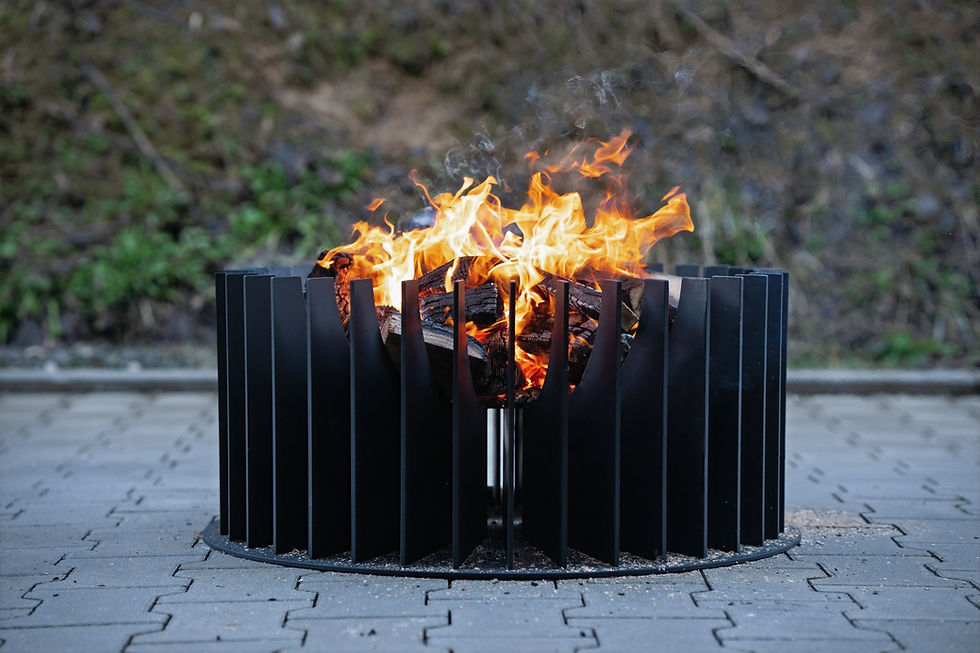
Fire pit in the garden: What is allowed – and what you should definitely pay attention to
A fire pit in your own garden creates atmosphere, provides warmth, and quickly becomes the focal point for convivial evenings. This shared experience around the fire is precisely the main reason why many people have a fire pit in their garden in the first place.
We at Blechdeckel love fire – and that's precisely why we know what's important when it comes to handling it safely and responsibly. To ensure you can use your garden fire pit safely, cleanly, and stress-free, we've compiled the most important points regarding planning, operation, distances, smoke prevention, and legal requirements – including practical tips, frequently asked questions, and resources for guidance.


-
Is It Even Permitted to Use a Fire Pit in the Garden?
In many municipalities, using a fire bowl in a private garden is generally permitted — as long as you operate it safely and do not cause unnecessary disturbance to others. Whether you need to register it or whether restrictions apply depends on local law. That is why it is worth taking a quick look at your municipality’s website or calling the public order office. (Source: 7) -
Important: Some municipalities clearly distinguish between a fire bowl (a small utility or comfort fire) and “open fire” such as a campfire. Depending on the location, an exemption permit may be required for open fire. (Source: 7)
-
As a guideline, official information sheets also often state that a fire bowl should only be used occasionally and only with suitable fuels. Section 4 para. 4 of the 1st Federal Immission Control Ordinance (1. BImSchV) is often referred to as the legal basis for this (natural untreated split wood or wood briquettes). (Source: 1, 3)
-
What Is Allowed in the Fire – and What Is Not?
If you want to avoid trouble, this is the most important point: use dry, untreated firewood or wood briquettes. This ensures cleaner combustion and significantly less smoke. (Source: 1, 3) -
Things that produce heavy smoke or release pollutants are prohibited — and are expressly identified as problematic in official information sheets: garden waste, rubbish/packaging, treated or painted wood, chipboard, and “smoke fires” using paper/cardboard. (Source: 3, 5)
-
Distance: How Far Away from the House, Hedge – and the Neighbour?
Many people look for a fixed number of metres “from the neighbour”. The reality is that there is usually no uniform nationwide distance for this. What matters is whether smoke or odour causes a noticeable disturbance to the neighbour — in legal terms, this is referred to as a “material impairment”. This is precisely the standard applied under neighbour law. (Source: 2) -
What you can plan very specifically, however, are safety distances from combustible materials. Official information sheets often state, as a practical guideline, that there should be at least 5 metres distance from combustible materials — for example wood piles, hedges, wooden fences, or combustible parts of buildings. (Source: 3)
-
How to Keep Things Stress-Free in Practice:
– Position the fire pit so that the smoke does not drift towards the neighbour’s patio or windows. (Source: 2, 3)
– Keep the surrounding area free from dry leaves, decorations, cushions, and stored wood. (Source: 3)
– If the wind picks up, it is better to pause or extinguish the fire early — sparks and smoke can quickly travel where you do not want them to go. (Source: 4) -
Avoiding Smoke: This Is the Most Common Cause of Disputes
Smoke is almost always the reason why problems arise. And in most cases, it is caused by one of these factors: wood that is too damp, unsuitable materials, or insufficient airflow.
How to achieve clean burning:
– Use only dry, untreated wood (no damp wood, no treated wood). (Source: 1, 3)
– Light it properly: start with dry kindling, then add small logs, and only add larger logs later. (Source: 3)
– Do not overload the fire: fire needs air, otherwise it will smoke. (Source: 3)
– If the wind conditions are unfavourable, it is better not to start the fire at all. (Source: 4) -
Fire Near Woodland?
Proximity to woodland is often underestimated. Depending on the federal state or forestry authority, open fire in the forest or near woodland may require a permit.
One example shows how strict this can be: in the Erzgebirgskreis district, anyone wishing to make a fire or use an open light in the forest or within less than 100 metres of the forest edge requires permission from the forestry authority. (Source: 6)
If your property is near woodland, be sure to check the requirements of your forestry authority or district administration before operating a fire pit. (Source: 6) -
Safety: Extinguishing Agents, Embers and Ash
These are the basics that really help:
– Keep extinguishing agents ready: water, sand, or a fire extinguisher within easy reach. (Source: 4)
– Never leave the fire unattended — not even “just for a moment”. (Source: 4)
– React in good time when it becomes windy, and preferably end the fire early. (Source: 4)
– Embers remain hot for a long time: only dispose of ash once everything has cooled down completely. (Source: 4)
– Avoid smoke so that no false alarm is triggered (e.g. due to heavy smoke development). (Source: 5) -
Material and Surface: What You Can Expect from Our Fire Pits
Our fire pits are made of solid steel. Ex works, our models have a heat-resistant coating. This provides protection during transport, storage, and the initial period of use — but it is not intended to guarantee a permanently perfect appearance for years. Due to heat, weather, and use, the coating may burn off or peel away.
Over time, a patina (surface rust) will develop. This is normal for untreated steel used outdoors and does not constitute a defect. -
Care That Really Makes a Difference:
– Remove ash regularly so that moisture cannot accumulate and cause damage (avoid standing moisture).
– If you are not using the fire pit for a long time, a cover will help.
– Visual touch-ups are possible: repainting with a suitable stove or heat-resistant paint is possible, but not strictly necessary. -
Conclusion
A fire pit in the garden is possible in many cases — provided that you use it cleanly and safely: suitable ground, sufficient distance from combustible materials, dry firewood, consideration for neighbours, and a quick check of local regulations. If you are unsure, it is worth checking the local rules — especially during dry conditions and near woodland. (Source: 7) -
Your Blechdeckel Team
-
Sources (numbered, with bullet sub-points)
Laws on the Internet (BMJ) – 1st Federal Immission Control Ordinance (1. BImSchV) Section 4 (para. 4)
• “only occasionally” / permissible fuels (natural untreated wood or wood briquettes)
• https://www.gesetze-im-internet.de/bimschv_1_2010/__4.html -
Laws on the Internet (BMJ) – German Civil Code (BGB) Section 906
• Standard of “material impairment” (e.g. smoke/odour)
• https://www.gesetze-im-internet.de/bgb/__906.html -
District Office Augsburg – Information Sheet “Barbecue Fires and Fire Bowls in the Garden” (19 May 2021)
• Practical rules on fuels, smoke/disturbance, guideline value of 5 m from combustible materials
• https://www.landkreis-augsburg.de/fileadmin/user_upload/Immissionsschutz/Merkblatt_Grillfeuer_und_Feuerschalen_im_Garten_2021-05-19.pdf -
German Firefighters Association (DFV) – “Outdoor Fires and Barbecuing – but Safely!”
• Safety instructions (supervision, wind, extinguishing agents, conduct during dry conditions)
• https://www.feuerwehrverband.de/feuer-im-freien-und-grillen-aber-sicher/ -
City of Kaufbeuren – Information Sheet “Handling Open Fire Outdoors” (PDF)
• Basic rules/obligations, notes on avoiding false alarms
• https://www.kaufbeuren.de/PortalData/17/Resources/pdf/sonstiges/Lagerfeuer.pdf -
Erzgebirgskreis – “Apply for Open Fire in the Forest or at the Forest Edge”
• Example regulation on permit requirements in the forest or less than 100 m from the forest edge
• https://www.erzgebirgskreis.de/landratsamt-service/struktur-aufgaben/anliegen-von-a-bis-z/offenes-feuer-im-wald-oder-am-waldrand-beantragen -
BayernPortal – “Open Fire; Application for an Exemption Permit”
• Example of administrative practice: open fire (e.g. campfire) may require an exemption
• https://www.bayernportal.de/dokumente/leistung/0192493891133 -
Bei Bedarf kann ich Ihnen den Abschnitt auch noch in werblich-sauberes Website-Englisch glätten, ohne die Aussage zu verändern.